
Emigrating to Marbella? What you need to know and check before you move
· 30 min. read · by Marbella Partner
Marbella sells itself on the weather. The weather is the easy part. At €3 million and above, whether the move works comes down to decisions most people rush, from how many days a year you spend here to how your wealth is held when you arrive.
This guide is for buyers from the Netherlands, Belgium and the UK looking at homes from around €3 million, whether they plan to live here full-time or for most of the year. We've put things in the order you'll run into them.
"During my years as owner of Christie's International Real Estate Costa del Sol, we helped many international buyers find homes and advised some to walk away when the risks were too high. The mistake I see most often is underestimating the importance of thorough checks, from the first occupancy licence (Licencia de Primera Ocupación, or LPO) to what may be developed nearby or even on the plot itself. Otherwise you could end up buying the seller's problems."
Hans Veenhuijsen, founder of MarbellaPartner
If you only check six things, check these.
- Count your days. Spend more than 183 days in Spain in a calendar year and you become tax resident, taxed on your worldwide income and, above a threshold, your worldwide wealth.
- Model the wealth tax before you move. Andalusia's relief does not remove wealth-tax liability for large fortunes. Model both regional wealth tax and Spain's solidarity tax, with liability starting around €4 million depending on exemptions.
- Decide how you'll hold the property. Personal names, a Spanish company and a foreign structure carry very different tax costs. Some offshore companies pay an extra 3% of cadastral value every year.
- Check the planning status. Marbella only replaced its 1986 town plan in September 2026, and some prime villas still carry irregularities.
- Know which estates go quiet. Even at the top of the market, some areas empty out from November. A buyer's agent who works here all year can tell you which before you view.
- Budget for purchase costs. On a €4 million resale villa, expect at least €330,000 in tax and fees.
Is Marbella lively all year round?
Mostly, yes. Marbella is a working town as well as a resort. The town hall counted 173,420 people on its municipal register at the start of 2026. About 36% are foreign nationals, and nine in ten people who registered during 2025 came from abroad (The Local, February 2026). The centre doesn't shut for winter. On a February Sunday the Old Town is full of Spanish families out for lunch.
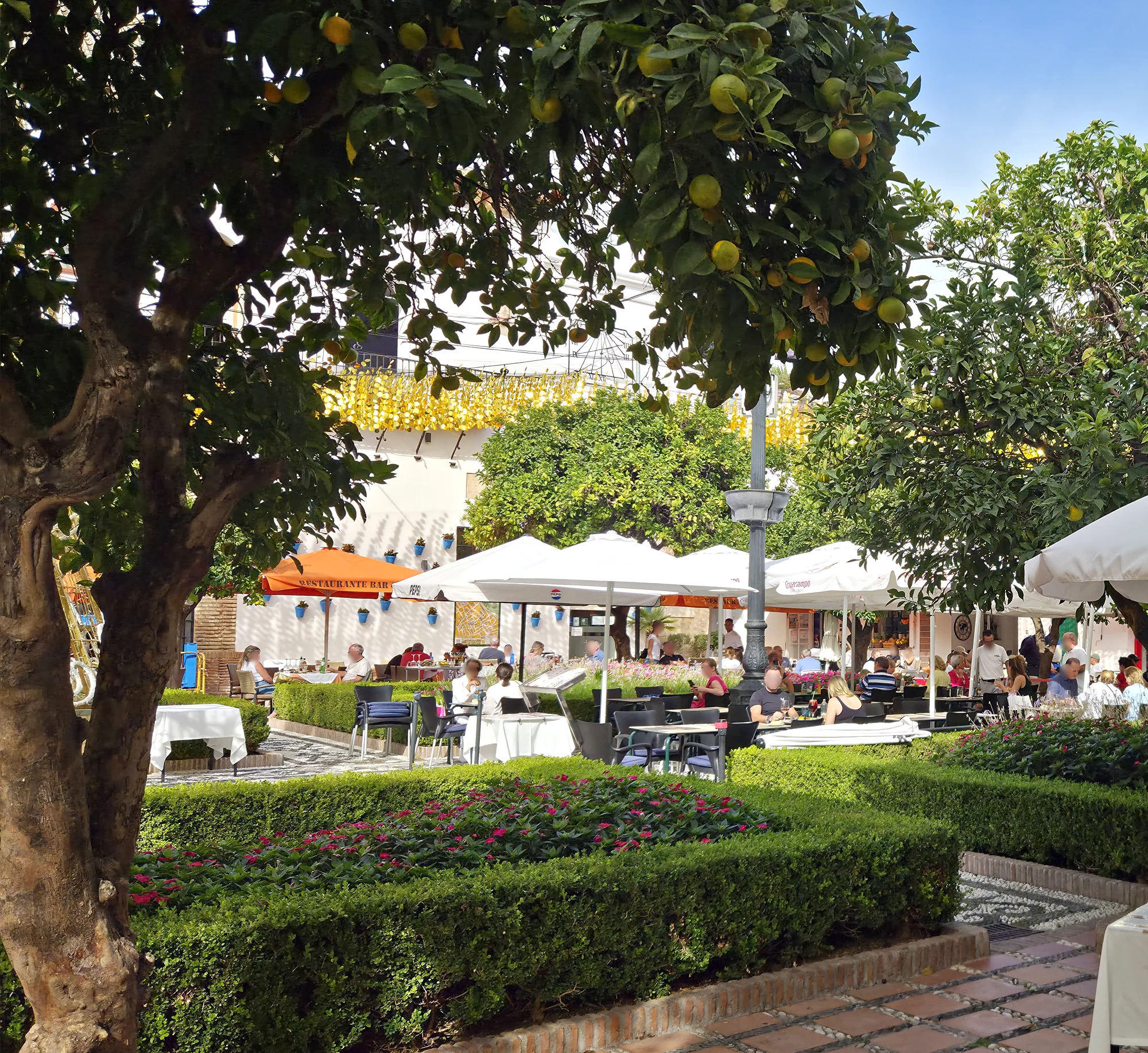
It isn't the same everywhere. Puerto Banús and parts of the beachfront in Elviria and Cabopino go quiet between November and March. In some gated estates most villas are second homes, so the road outside can be empty midweek in January.
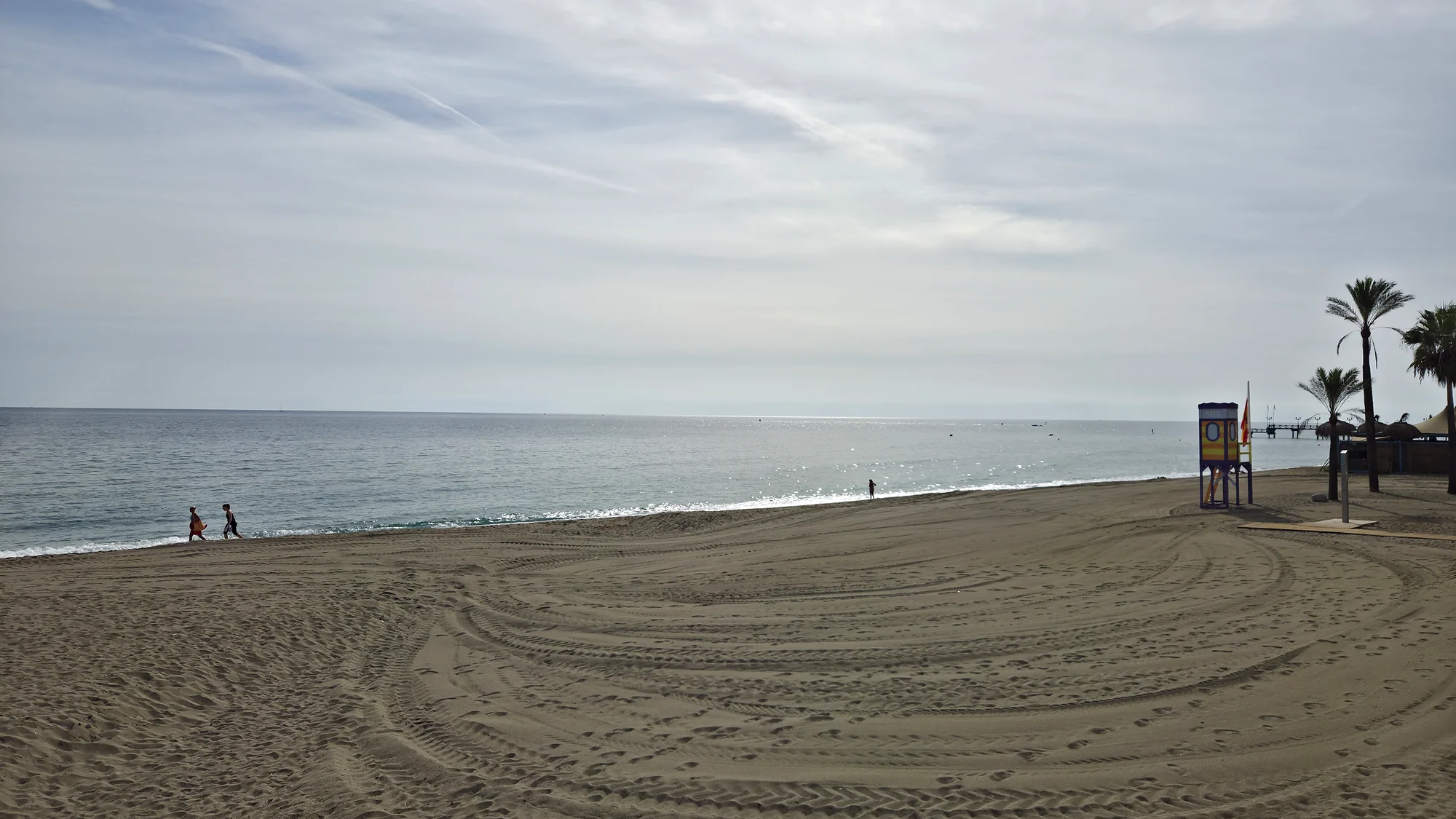
Listings won't tell you which estates are lived in all year. A buyer's agent who works the area year-round can, and can show you both kinds in the low season before you commit.
Which part of Marbella suits you?
Marbella's municipality runs along roughly 27 km of coast, from Guadalmina in the west to Cabopino in the east, with around two dozen beaches (Hosteltur). At the top of the market the choice narrows to a handful of districts, and within them to particular streets. The table runs west to east, with idealista's asking-price averages for September 2026 (idealista).
| Area | At the top end | District average | Often suits |
|---|---|---|---|
| Guadalmina and San Pedro Alcántara | Beachside and golf villas in Guadalmina Baja, next to a more Spanish town centre | €4,649 per m² (San Pedro district) | Families who want the beach and a working town close by |
| Nueva Andalucía | Golf-front villas around Las Brisas, Los Naranjos and Aloha, close to Puerto Banús | €6,214 per m² | Golfers, and families near Aloha College |
| Golden Mile and Sierra Blanca | Nagüeles, Cascada de Camoján and gated Sierra Blanca on the hillside, Puente Romano and Marbella Club by the beach | €8,331 per m² (Nagüeles–Milla de Oro) | Buyers who want the most established addresses, close to both the Old Town and Puerto Banús |
| Río Real and Los Monteros | Beachside and hillside villas on larger plots east of the centre | €5,610 per m² | Buyers who want space and the beach without Golden Mile density |
| Las Chapas and Hacienda Las Chapas | Hillside villas on bigger plots, some with wide sea views | €5,446 per m² (Las Chapas–El Rosario) | Privacy seekers who don't need town life on the doorstep |
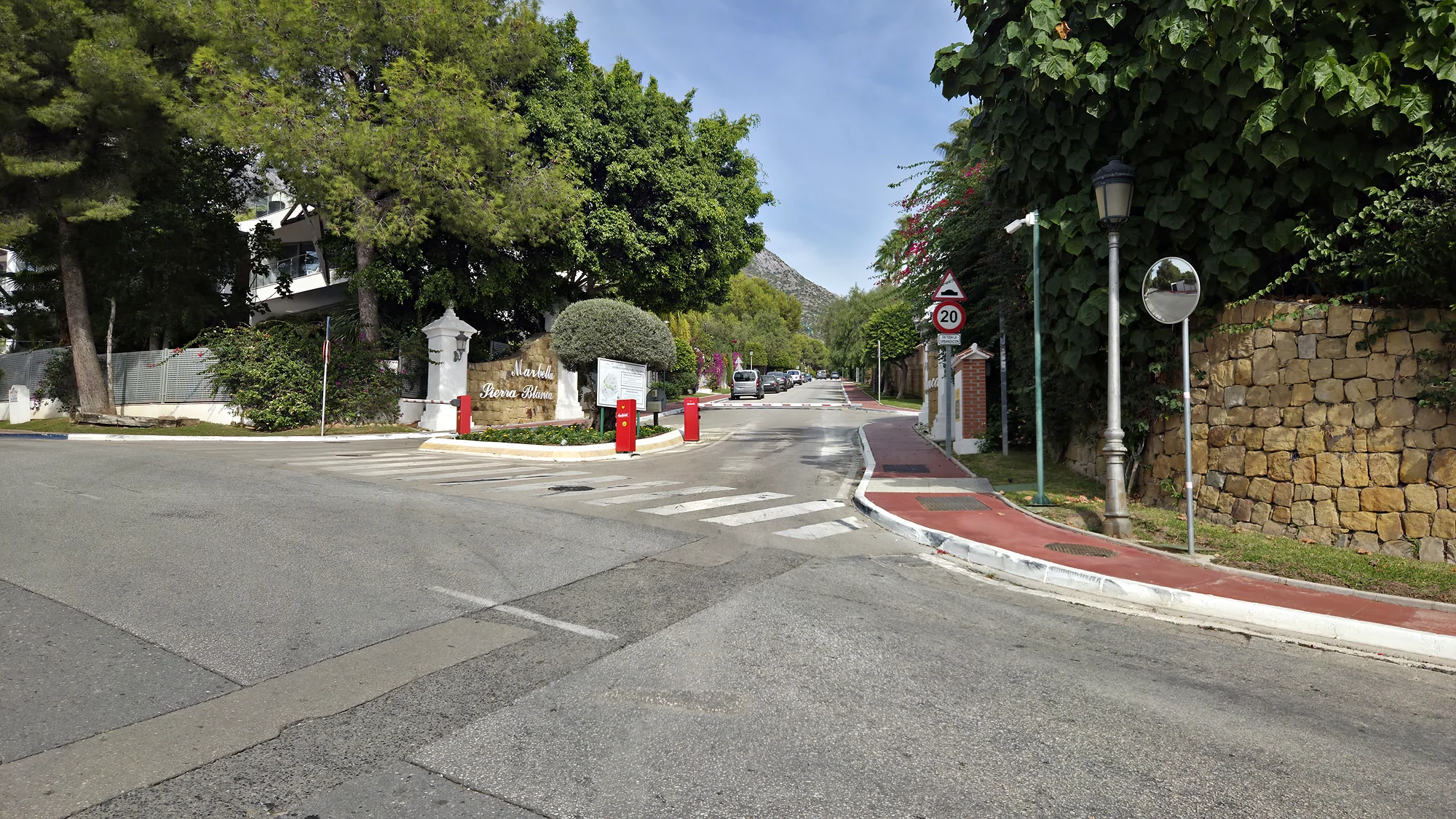
District averages include apartments, so they understate the top end. Idealista's August 2026 ranking of Spain's most expensive addresses puts Cascada de Camoján, in the hills above the Golden Mile, at a median asking price of €6.4 million. Coto Zagaleta in neighbouring Benahavís comes third in Spain, at €10.5 million (El Español, citing idealista).
Many buyers at this level also look just over the border, at the gated estates of La Zagaleta and El Madroñal in Benahavís, or further west at Sotogrande.
Which paperwork do you need, and in what order?
EU citizens don't need a visa to live in Spain, but anyone staying longer than three months must register as a resident. UK citizens have needed a residence visa since Brexit, which the UK section below covers.
- NIE (Número de Identidad de Extranjero). Your foreigner's identification number. You need it for almost everything, from buying a property to signing up for electricity. You can apply before you move through a Spanish consulate, or at a police foreigners' office once you're here.
- Padrón. Registration on the municipal roll at the Ayuntamiento de Marbella, using your passport and your title deed or rental contract. Schools and health centres will both ask for the certificate.
- EU registration certificate. The Certificado de Registro de Ciudadano de la Unión, issued by the Policía Nacional's foreigners' office. Apply in person within three months of arriving. You'll need proof that you work here, or that you have enough income and health insurance to support yourself. Once the fee is paid, the certificate is issued on the spot (Policía Nacional).
- Healthcare. Register at your local centro de salud once your Social Security affiliation or S1 is in place.
- Tax. Once you're tax resident, you file a Spanish income tax return each spring for the previous calendar year. For 2025 income the window ran from 8 April to 30 June 2026 (El Independiente).
Appointments at the foreigners' office (cita previa) can take weeks to appear online. Book early. Most buyers at this level hand the whole process to a gestor or lawyer. Spain's anti-money-laundering law (Ley 10/2010) obliges your bank, the notary and the land registry to run checks on you (Sepblac). Expect to show where your money comes from, and have the paperwork ready before you transfer anything.
How does healthcare work when you move to Marbella?
How you get into the public system depends on how you'll live here.
- Working or self-employed in Spain. Social Security contributions give you access to the Andalusian public health service (SAS).
- Receiving a state pension from another EU country or the UK. You'll usually qualify for an S1 form from your home country. Register it with Spain's Social Security institute (INSS) and you're covered by the SAS on the same terms as Spanish pensioners.
- Not working here and not yet on a state pension. You'll need private health insurance to register as a resident, and most buyers at this level keep international cover anyway. After a year's residence, and with your padrón certificate, you can also buy into the public system through the convenio especial, at €60 a month under 65 and €157 from 65 (Ministerio de Sanidad).
Most buyers at this level use the private hospitals. Quirónsalud Marbella runs a 24-hour emergency department and works with hundreds of international insurers (Quirónsalud). HC Marbella has agreements with Bupa, Cigna, Aetna and other international providers (HC Marbella), and Hospital Ochoa sits on the seafront. The main public hospital is the Hospital Costa del Sol, on the A-7 east of town.
Many expats here also take out a membership with Helicópteros Sanitarios, a long-established private home-doctor and emergency service based in Puerto Banús (andalucia.com). For a fixed fee, members can call out a doctor 24 hours a day, at home or anywhere between Torremolinos and Sotogrande. It also runs 24-hour clinics in Marbella, Fuengirola and Sabinillas (Helicópteros Sanitarios).
Families with young children use it most. A child's fever at 2am or a bad fall gets seen at home. No hours in urgencias, the hospital emergency department, and no queue at the health centre.
Check what your plan covers and what it costs this year. Medical repatriation flights, for example, are quoted separately. For anything life-threatening, call 112.
Don't cancel your health cover at home until the Spanish cover is confirmed in writing.
When do you become a Spanish tax resident?
You're tax resident in Spain if you spend more than 183 days here in a calendar year, or if your main business or economic interests are here (Article 9, Ley 35/2006 on personal income tax). If your spouse and minor children live in Spain, the tax office presumes you do too. Short trips abroad still count as days in Spain unless you can prove you're tax resident somewhere else.
As a resident you pay Spanish income tax on your worldwide income. The tax treaty between Spain and your home country decides who taxes what and prevents double taxation. Pensions and investment portfolios cause the most surprises. Take advice before you deregister at home.
Will you pay wealth tax in Marbella?
Probably, if you become resident. While the solidarity tax remains in force, Andalusia replaces its general 100% wealth-tax relief with relief calculated against that tax. Regional wealth tax paid is deductible from solidarity tax, so the two must be assessed together (Junta de Andalucía). Residents pay it on worldwide net wealth. After a €700,000 allowance and up to €300,000 of exemption for a main home, it starts at about €4 million (Andersen).
Rates are 1.7% on taxable wealth between €3 million and about €5.35 million, 2.1% up to about €10.7 million and 3.5% above that (KPMG). As an illustration, a resident with €8 million of net wealth, including a main home, would pay roughly €74,600 a year before caps or exemptions.
Two rules soften it. Income tax, wealth tax and solidarity tax together can't exceed 60% of your taxable income, although that cap can't cut the solidarity tax by more than 80% (Fieldfisher). Shares in a qualifying family business can also be exempt.
Staying non-resident doesn't take you out of it. Non-residents also receive the €700,000 allowance (Agencia Tributaria). Non-residents pay on Spanish assets above roughly €3.7 million after the €700,000 allowance, and the 2022 law that created the tax also brought in shares in foreign companies whose value comes mainly from Spanish property (KPMG).
Other rules that matter at this level
- Inheritance and gift tax. In Andalusia, spouses, children and parents get a €1 million reduction each on the taxable amount and then a 99% relief on the tax itself, under Ley 5/2021 (Agencia Tributaria de Andalucía, Interforo Abogados, 2026). That takes most family inheritances close to zero. Gifts must meet formal conditions, so take advice before you transfer money.
- Foreign assets. Residents must declare foreign accounts, investments or property worth more than €50,000 per category on the Modelo 720, by 31 March. Penalties were cut back after a 2022 ruling by the EU Court of Justice, but the duty to file remains. Crypto held abroad goes on a separate form, the Modelo 721.
- Beckham regime. If you move to Spain to work, including as a company director or entrepreneur under the 2022 Startup Law, you can opt to pay a flat 24% on employment income up to €600,000. It covers the year you arrive and the next five. You also pay wealth and solidarity tax on your Spanish assets only, and skip the Modelo 720 (Moving to Spain). You can't have been tax resident in Spain in the previous five years, and you must apply within six months of registering with Spanish Social Security (TaxDown, June 2026).
Staying under 183 days? Then you're normally a non-resident. You pay Spanish tax on Spanish income only, plus an annual non-resident tax on any property you own here, worked out from its cadastral value at 19% for EU and EEA residents and 24% for everyone else.
What should you arrange before leaving the Netherlands?
The Dutch side of the move needs as much attention as the Spanish side, especially if you own a business. Leave it late and you can lose pension rights or face an open-ended tax claim on your company shares.
- Deregister from the BRP. Tell your gemeente you're emigrating if you'll live abroad for more than eight months within a year. You can do it from five days before you leave up to the day itself (NederlandWereldwijd).
- Exit tax on your shares and pension. Expect an M-form covering the emigration year, followed by a conservatory assessment (conserverende aanslag). On pensions and annuities it's normally deferred for ten years, but cashing one in early can trigger it. On a substantial shareholding of 5% or more, it has no end date (Belastingdienst).
- Pension tax. How Spain and the Netherlands split tax on AOW, company pensions and lijfrentes depends on the bilateral tax treaty and the type of pension. Get it modelled before you move. Use an adviser who works across both systems, not two who each see half the picture.
- Health insurance. Once you no longer live in the Netherlands, you generally fall out of the Zvw and Wlz and your basisverzekering ends. AOW pensioners usually get Spanish public healthcare through an S1 arranged via the CAK, and pay a monthly contribution (verdragsbijdrage) in the Netherlands.
- Early retirement. From 1 November 2026, people who emigrate to an EU country on an early retirement pension are expected to lose the right to healthcare through the CAK. They'll need their own insurance until AOW age, though existing CAK customers keep their rights (CAK).
- AOW. You stop building AOW for the years you live outside the Netherlands, at 2% of the full pension per year. Voluntary insurance with the SVB fills the gap, but you must apply within a year of leaving and it usually runs for ten years at most (NederlandWereldwijd).
Moving from Belgium? The steps look similar but the rules differ, so check with your gemeente and the FOD Financiën before you set a date.
What changes if you're moving from the UK?
Since Brexit, UK citizens count as non-EU nationals in Spain. You can stay up to 90 days in any 180-day period without a visa. Owning a home here doesn't change that. Living in Marbella for longer means applying for a residence visa at the Spanish consulate in the UK before you move.
- Inheritance tax follows you. Since 6 April 2025 the UK taxes estates on long-term residence rather than domicile. If you've been UK resident for at least 10 of the last 20 years, your worldwide estate stays inside UK inheritance tax for three to ten years after you leave, depending on how long you lived there (Norton Rose Fulbright). Plan the UK and Spanish sides together.
- Non-lucrative visa. For people who won't work in Spain. The income test, €2,400 a month for the main applicant in 2026 plus €600 per family member, won't be the issue at this level (Spanish Ministry of Foreign Affairs). The ban on working here might be, so check how it fits with any business you still run.
- Digital nomad visa. For people working remotely for employers or clients mostly outside Spain. Published 2026 thresholds range from about €2,760 to €2,850 a month, so confirm the number with your consulate.
- Golden visa. A €5 million villa no longer buys residence. Spain ended the property golden visa on 3 April 2025 (Ley Orgánica 1/2025).
- Residence card. After arriving on a visa, apply for your TIE card within a month of entering Spain (Universitat de València).
- Before you leave. Tell HMRC with form P85. If you draw a UK state pension, ask NHS Overseas Healthcare Services for an S1.
- Driving. Your UK licence is valid for six months after you become resident. Exchange it for a Spanish one within that window, or you'll have to stop driving until the swap is done (The Local).
Can you work or start a business from Marbella?
Increasingly, yes. Marbella used to be where people came to retire. Now founders and remote workers are setting up here, and the town wants to pitch the Costa del Sol as Europe's answer to Silicon Valley, with Marbella playing Palo Alto (Fortune/Bloomberg, 13 July 2026).
The push is often called Marbella 2.0. One of its hubs is The Pool, a coworking and business centre that opened in May 2023 on the top floor of a former El Corte Inglés furniture store. Five Swedish and two local entrepreneurs founded it, and it's home to the Marbella Tech Meetup (The Pool). Its CEO, Christian Rasmusson, has travelled with the mayor to China to sell Marbella as a gateway into Europe.
The town hall is pushing too. Its Marbellup programme teaches residents to use AI, and in June 2026 Marbella hosted Startup Olé, an event for tech companies. The newcomers are real. Bob van Winden, a Dutch tech veteran who worked at Google and Stripe, chose Marbella over Madrid for his family because of the schools and the quality of life.
It isn't Silicon Valley yet. Josemaria Siota of IESE Business School told Bloomberg the pieces are in place but the ecosystem has yet to mature (Fortune/Bloomberg).
National rules help too.
- Investing in startups. The Startup Law raised Spain's income tax deduction for investing in new or recently created companies to 50%, on up to €100,000 a year (El Derecho).
- Starting a company. Certified startups pay 15% corporate tax instead of 25% for their first four years with a taxable profit (Agencia Tributaria). Certification comes from ENISA, the state-owned innovation lender.
- Moving to work here. The same law widened the Beckham regime to directors and entrepreneurs and created the digital nomad visa, both covered above.
Should you rent before you buy in Marbella?
Yes, if you can. A winter let of a comparable villa shows you which estate fits your routine, and how the house copes with damp. It also gives you time to set up banking and agree the ownership structure without rushing.
When you do buy, the taxes depend on whether the home is a resale or a new build from a developer. The last column works through a €4 million resale villa.
| Cost on top of the price | Resale home | New build from a developer | €4 million resale villa |
|---|---|---|---|
| Transfer tax (ITP) | 7%, on the price or the Catastro reference value, whichever is higher | Not charged | €280,000 |
| VAT (IVA) | Not charged | 10% | Not charged |
| Stamp duty (AJD) on the deed | Not charged | 1.2% | Not charged |
| Notary and land registry | Set by official scales; a few thousand euros at this price | Same | About €3,200 including VAT |
| Independent lawyer | Usually 1% to 1.5% plus 21% IVA, or a fixed fee | Same | €48,400 at 1% plus IVA |
| Total | About €331,600, or 8.3% |
The tax rates are Andalusia's rules for 2026 (TaxDown, September 2026). Notary and land registry fees are fixed by official scales (Real Decreto 1426/1989 and 1427/1989), which we've applied to a €4 million price, including the standard discounts and 21% VAT (Tinsa, April 2026). Lawyers usually charge 1% to 1.5% of the price or a fixed fee (Asesor.legal, 2026). At this level, agree a fixed fee before you start.
Prices are at a record. Asking prices in Marbella averaged €5,967 per m² in September 2026, the highest in idealista's series (idealista), and roughly 74% more than in mid-2021 (Fortune/Bloomberg).
Branded residences are a growing slice of the top end, with projects from Giorgio Armani with Rafael Nadal, Dolce & Gabbana, Fendi and Karl Lagerfeld (Fortune/Bloomberg). Bought new from the developer, they carry VAT and stamp duty rather than transfer tax.
Marbella has a few traps of its own.
- Planning status. Marbella approved a new town plan, the PGOM, in September 2026. It replaces the 1986 plan that came back into force when Spain's Supreme Court annulled the 2010 plan in 2015. Around 18,000 homes with past planning problems now have a clearer route to regularisation, but none becomes legal automatically, and the detailed POU plan is still being processed (Euro Weekly News, 19 September 2026). Your lawyer should check the land registry, the Catastro and the town hall's planning department, and confirm the home has a first occupation licence or an AFO declaration.
- How you hold it. Most buyers buy in their own names. A company based in a jurisdiction Spain treats as non-cooperative pays a special levy of 3% of the cadastral value every year (Agencia Tributaria), and foreign companies holding Spanish property now count for solidarity tax. Agree the structure with your tax adviser before you sign the reservation contract.
- Buying from a non-resident seller. You must withhold 3% of the price and pay it to the tax office as a guarantee against the seller's capital gains tax. Your lawyer handles this at completion.
- Letting it out while you're away. Since 3 April 2025, a new holiday let in an apartment building needs approval from three-fifths of the owners' community (Cuatrecasas). Holiday lets also need registering with Andalusia's tourism register, and since July 2025 with a national registry before they can be advertised on platforms. Read the community's rules before you sign anything.
How easy is it to get around from Marbella?
Easy by air, harder on the ground. Most residents fly from Málaga-Costa del Sol airport, about 50 km east of Marbella centre. It handled a record 26.76 million passengers in 2025 (Aena). The Netherlands is one of its biggest markets, with almost 155,000 passengers flying between Málaga and Dutch airports in June 2025 alone (Aena). Gibraltar and Seville are alternatives for some routes.
There's no train. Marbella is regularly cited as the only Spanish city of more than 100,000 people without a rail link, and the nearest commuter station is at Fuengirola, at the end of the C1 line to Málaga. A government feasibility study for a coastal line is due by the end of 2026 (El Español, July 2026), and the new town plan protects land for a possible rail connection. Even if it goes ahead, a train is years away. Buses run to the airport and to Málaga, but most residents drive.
Two roads run along this stretch of coast. The A-7 is free but slow in summer and at rush hour. The AP-7 toll motorway runs parallel and is much quicker at peak times. For most families, the school run and the airport drive end up mattering as much as the view. Flying private? Málaga airport has a separate General Aviation Terminal with its own VIP area (andalucia.com).
Bringing your car? Once you're resident, you can't keep driving it on foreign plates. You'll need to register it in Spain, which means a technical inspection and a registration tax based on CO2 emissions. You can be exempt from that tax if you're moving here after at least a year living abroad. The car must have been in use in your old country for at least six months before you left, and you can't sell it for a year after registering (Agencia Tributaria).
What are the school options in Marbella?
Families choose between free Spanish state schools and private international schools. School is compulsory from age 6 to 16.
International schools in the municipality include Aloha College in Nueva Andalucía, Swans International School, English International College, Laude San Pedro International College and the German school, Deutsche Schule Juan Hoffmann, in Elviria. Most follow the British curriculum, and Aloha College and Swans both offer the International Baccalaureate Diploma (Aloha College, Good Schools Guide). For boarding, Sotogrande International School, further west along the coast, runs the full IB programme from age 3 to 18.
Choice has grown fast. The director of English International College told Bloomberg the area had about 11 international schools 40 years ago and has more than 50 now. Popular year groups fill early, so contact schools a year ahead.
For a state school you apply through the Junta de Andalucía's admissions process. Applications run from 1 to 31 March for places starting in September (El Español, February 2026), and you'll need your padrón certificate.
Younger children tend to adapt to Spanish quickly. Teenagers often find the switch harder, which is why many families choose an international school for the secondary years. Dutch children can keep up their Dutch with NTC lessons (Nederlandse Taal en Cultuur). Search for Spain in the NOB foundation's school finder to see what's on offer locally. If there's no school close by, the lessons can be taken online (Netherlands Worldwide).
What is the climate really like, and what does it mean for your home?
Winters are mild and summers are hot and dry. At Málaga airport, AEMET's long-term averages show a mean annual temperature of 18.5°C, 2,905 hours of sunshine and 534 mm of rain, most of it between October and April (AEMET, 1981–2010 normals). Marbella sits about 50 km west below the Sierra Blanca, so treat those numbers as a guide rather than an exact match.
Compare winters with the Netherlands. Between December and February, Málaga airport averages about 520 hours of sunshine and 12.7°C. De Bilt averages 211 hours and 3.9°C over the same three months (KNMI, 1991–2020 normals). That's roughly two and a half times the winter sun. The two agencies use different reference periods, so read it as a rough comparison.
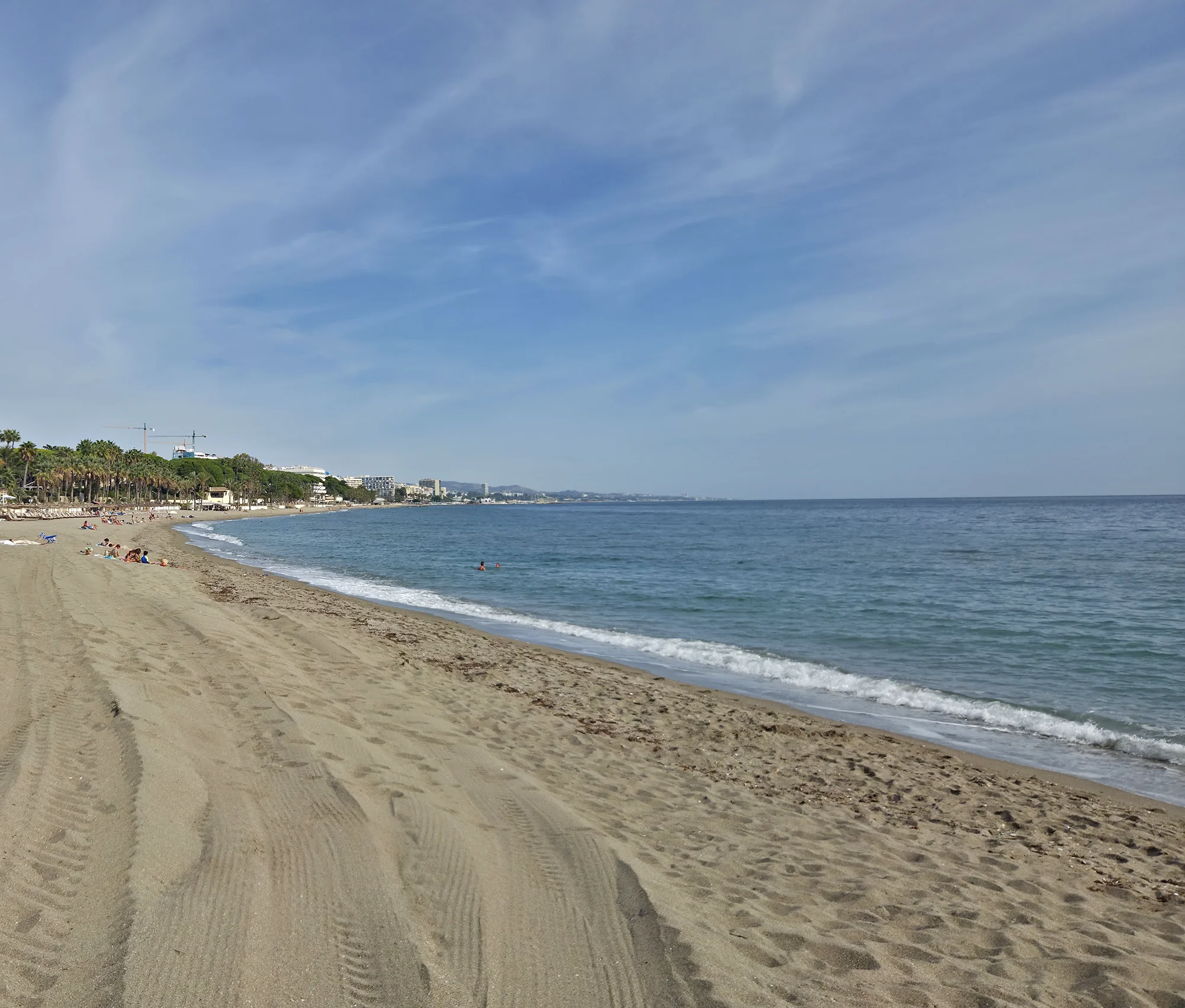
Winter can feel colder indoors than out. Many villas were designed for August, with stone floors and walls of glass, and older ones may lack proper heating or insulation. Heating and glazing matter more than they seem on a summer viewing, and so does which way the bedrooms face.
Summer is the opposite problem. July and August are hot, and air conditioning is standard in most modern homes, though not always in every bedroom.
Then there's water. In December 2023 the Junta de Andalucía declared an exceptional drought on the western Costa del Sol, and through 2024 councils restricted pool filling and garden watering (Ayuntamiento de Estepona). Rain has since restored normal supply levels (Vozpópuli), but it's worth checking how a home copes in a dry year. Ask whether it has its own water tank (depósito) and how the garden is irrigated. A garden planted for Andalusian summers costs far less to keep alive than a lawn.
A large villa runs like a small business. Budget for a housekeeper and gardener, pool and security maintenance, insurance and the annual IBI property tax, which the town hall levies on the cadastral value. In Marbella the 2026 rate is 0.65%, and cadastral values usually sit well below market prices (Guía Fiscal).
Frequently asked questions about moving to Marbella
Can I live in Marbella without speaking Spanish?
Day to day, largely yes. English gets you a long way in shops and private clinics. Dealing with the town hall or the public health service is another matter. Even basic Spanish helps. Marbella's public language school, the Escuela Oficial de Idiomas, runs Spanish courses for foreigners at several levels.
How long does it take to become a resident in Marbella?
For EU citizens, the registration certificate is issued at the appointment itself once the fee is paid (Policía Nacional). The wait is for the appointment. UK citizens apply for a visa in the UK first, then for a residence card within a month of arriving.
Do I pay tax in Spain if I spend half the year in Marbella?
It depends on the count. More than 183 days in a calendar year makes you a tax resident in Spain. Below that you're normally a non-resident, taxed only on Spanish income plus an annual tax on any property you own here.
Will I pay wealth tax if I move to Marbella?
If your net wealth is above roughly €4 million, probably. Regional wealth tax and solidarity tax must be assessed together, taking account of reliefs and credit for wealth tax paid. The solidarity tax's marginal rates are 1.7% to 3.5%. Non-residents pay it on Spanish assets above roughly €3.7 million after the €700,000 allowance.
How much does a prime villa in Marbella cost?
District averages run from about €4,650 to €8,330 per m² (idealista, September 2026), but they include apartments. At the very top, idealista puts the median asking price at about €6.4 million in Cascada de Camoján and €10.5 million at Coto Zagaleta in Benahavís (El Español, August 2026). Running costs, private schools and international health cover are what most often surprise families at this level.
Does buying a home in Marbella give me the right to live in Spain?
No. Spain ended its golden visa for property buyers in April 2025. EU citizens don't need one anyway, and non-EU buyers need a separate visa such as the non-lucrative visa.
Do I need a buyer's agent in Marbella?
The law doesn't require one, but at this level most buyers are better off with one. In Spain the agent listing a property usually works for the seller. A buyer's agent works only for you. Buying here is about much more than finding the right villa. It's about making the right investment and avoiding the mistakes that cost the most.
- The whole market. Listed homes plus off-market villas that never reach the portals. A good buyer's agent hears about them early.
- Independent advice. Recommendations built around your brief, from someone not tied to any seller, developer or listing.
- Price and conditions. Asking prices and sale prices can sit far apart. An agent who sees real completions knows what a villa is worth and negotiates the price and terms for you.
- Due diligence. Checks on the property and the transaction, coordinated with your lawyer, tax adviser, architect and surveyor.
- Local knowledge. Which estates are lived in all year, which streets flood in a storm, which homes have a planning history. None of it shows up on a portal.
- One person, start to finish. Personal guidance from the first viewing to the signing at the notary, with your name kept out of the market until you're ready.
Your lawyer still handles the legal checks.
Why MarbellaPartner?
MarbellaPartner works only for buyers. Founder Hans Veenhuijsen has more than 25 years in luxury real estate and owned Christie's International Real Estate Costa del Sol from 2018 to 2025, and the firm works in cooperation with it today. He handles every assignment himself, in English, Dutch or German, and every engagement starts with an NDA.
In most cases you pay no extra acquisition fee. MarbellaPartner is paid from a share of the commission of the agency selling the property, as is standard in Spain, and any other arrangement is agreed upfront (How we work).
About MarbellaPartner
MarbellaPartner is an independent buyer representation firm in Marbella, founded by Dutch real estate adviser Hans Veenhuijsen. It acts for buyers, mostly from the Netherlands, Belgium and the UK, looking at homes from around €3 million on the western Costa del Sol. Hans has more than 25 years in luxury real estate, seven of them as owner of Christie's International Real Estate Costa del Sol, and works in English, Dutch and German.
This guide is general information, not tax or legal advice. Rules change, so check your own situation with a qualified adviser before you move.